Event 1 of 7 · Lan Xang, the kingdom of a million elephants · 1353
Fa Ngum’s march and the founding of Lan Xang
Fa Ngum’s army ⚔ Rulers of the Mekong towns
In 1353 a prince who had grown up in exile at Angkor came back up the Mekong with an army, joined the Lao towns into one kingdom and was crowned at Muang Sua, today's Luang Prabang. The kingdom he founded, Lan Xang, lasted more than 350 years.
Fa Ngum’s army Rulers of the Mekong townsCamps and routes are placed from historical records and memorials; positions are approximate.
A prince raised in exile
Fa Ngum was born in 1316 into the ruling family of Muang Sua, the town where the Nam Khan meets the Mekong. When he was still a child, his grandfather, the ruler, sent his father away from the court, and the family went south to Angkor, the capital of the Khmer kings.
There Fa Ngum was brought up by a Buddhist teacher, the monk Maha Pasaman, and married a Khmer princess, Keo Kengkanya. The chronicles say the Khmer king gave him an army — tradition speaks of 10,000 men — to win back his homeland.
The march up the Mekong
Around 1349 the army set out north along the Mekong. Champasak came over to Fa Ngum first; the land of Sikhottabong, around today's Thakhek, followed. Then he turned inland, crossed the mountains to Muang Phuan on the Xieng Khouang plateau and came down on Muang Sua from the east.
Some towns joined him through marriage alliances and oaths, others were taken by force. The chronicles tell the story in a few lines, so the route on the map is a reconstruction of the order of places, not a surveyed road.
The crowning at Muang Sua
In 1353 Fa Ngum was crowned at Muang Sua as king of Lan Xang Hom Khao, 'the million elephants and the white parasol': the elephants stood for military strength, the white parasol for kingship. Soon afterwards Viang Chan — Vientiane — accepted his rule as well.
Fa Ngum made Theravada Buddhism the faith of the court. In 1359 the Khmer king sent him the Pha Bang, a standing Buddha of gold, silver and bronze, as a sign of the new kingdom's blessing; much later it gave Luang Prabang its name.
What happened next
After Keo Kengkanya died, the king's rule grew harsh, and in 1373 the nobles of his own court sent him into exile, where he died in 1393. His son Samsenthai took the throne and organised the kingdom; the name 'Samsenthai' recalls a census of 300,000 Tai men.
Lan Xang stayed one kingdom until 1707 and spread from the far north of today's Laos to the Khone falls in the south.
Reading the map
The red flags follow the order of places in the Lao chronicles: Champasak, Sikhottabong, Muang Phuan, Muang Sua, then Vientiane. Positions are those of the old towns as far as they are known; the arrows show the direction of the march, not exact roads.
Outcome: The Lao towns were united as one kingdom, Lan Xang, which lasted more than 350 years.
Points on the route (5)
- 1
Champasak joins Fa Ngum
The march begins in the south. Champasak joins Fa Ngum, and the army moves north along the Mekong.
- 2
Sikhottabong (Thakhek area)
The land of Sikhottabong, around today's Thakhek, comes under his rule; its great stupa, That Sikhottabong, still stands by the river.
- 3
Muang Phuan, Xieng Khouang
The army leaves the river and climbs to Muang Phuan on the Xieng Khouang plateau, the land of the Plain of Jars.
- 4
Muang Sua — crowned king, 1353
Fa Ngum takes Muang Sua and is crowned king of Lan Xang in 1353 — the town that later became Luang Prabang.
- 5
Viang Chan (Vientiane) submits
Viang Chan, today's Vientiane, accepts his rule, and the Lao towns of the middle Mekong become one kingdom.


Follow it today
 2Royal Palace Museum (Haw Kham)ຫໍຄຳLuang PrabangThe last kings' palace, now a museum — and home of the Phra Bang, the Buddha image that gave Luang Prabang its name.
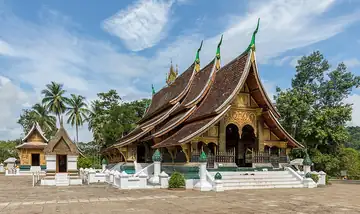 1Wat Xieng ThongວັດຊຽງທອງLuang PrabangThe royal temple of Luang Prabang, with sweeping roofs and a glittering “tree of life” mosaic.
 18Muang Khoun (Old Xieng Khouang)ເມືອງຄູນXiengkhouangThe old Phuan capital: a war-scarred Buddha among brick pillars and a 30-metre brick stupa from 1576.
 21That SikhottabongພະທາດສີໂຄດຕະບອງKhammouaneThe most sacred stupa of central Laos, on the Mekong bank south of Thakhek — about 29 m tall, with a gilded spire.
 27Si Phan Don (4,000 Islands)ສີ່ພັນດອນChampasakNear the Cambodian border the Mekong spreads into countless islands and channels; slow days on Don Det and Don Khon.
🍜 Famous food nearby

Or lam ເອາະຫຼາມ
Luang Prabang's signature stew of meat, eggplant, beans and greens, thickened with sticky rice and flavoured with sakhan, a peppery wood that leaves a tingle on the tongue.
Photo: Jpatokal · CC BY-SA 4.0 via Wikimedia Commons
What historians still debate
- How much of the army came from Angkor? The Lao chronicles give the credit to Khmer support; many historians think local alliances along the Mekong mattered just as much.
- The dates differ slightly between versions of the chronicles: the march is put at 1349–1353, and some lists give the coronation as 1354.
- When the Pha Bang reached Luang Prabang: one tradition says it stopped for a long time at Vieng Kham near Vientiane and only came to Luang Prabang in the early 16th century.
Questions people ask
What does Lan Xang mean?
'A million elephants'. The full name, Lan Xang Hom Khao, adds 'and the white parasol' — elephants for military power, the white parasol for kingship.
Where was Fa Ngum crowned?
At Muang Sua, the town at the meeting of the Mekong and the Nam Khan that later took the name Luang Prabang, after the Pha Bang Buddha.
Where can I see something from Fa Ngum's time?
The Pha Bang, which the Khmer king sent to Fa Ngum in 1359, is kept in the Haw Pha Bang at the Royal Palace Museum in Luang Prabang.
Sources
Camps and routes are placed from historical records and memorials; positions are approximate. · Open in Google Maps ↗